
Call for Papers – Issue #3
Architecture, Colonialism and East Asian Labour
Guest Editor: Jingliang Du (University of Hong Kong)
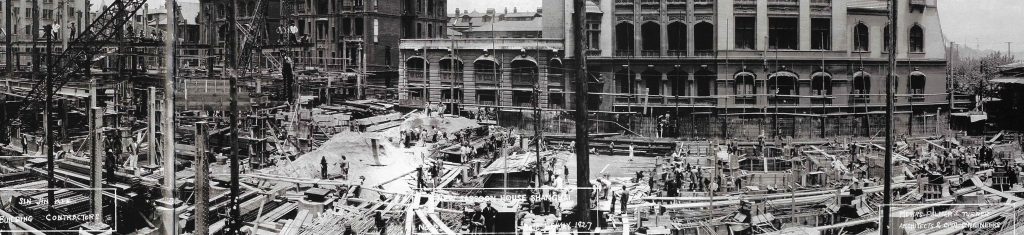
This issue invites contributions that examine how architectural labour sustained, mediated, and contested colonial and imperial power, with a focus on East Asian contexts through the twentieth century. The call asks what becomes visible when buildings, infrastructures, and urban spaces are approached through the labour that produced them. Who recruited, trained, and supervised those who built? How were skills transmitted, tools adapted, and materials handled across local, colonial, and imperial systems? How did subcontracting practices and everyday negotiations shape relations of authority on building sites? Taken together, what forms of knowledge, dependency, conflict, and resistance emerge when construction is treated as a social and political process?
Labour has emerged as a generative lens for architectural and urban history, reorienting attention from completed objects toward the conditions and relations of their making. Recent work on Chinese workers on the Yunnan–Indochina Railway (Selda Altan, 2024) and initiatives such as the Stanford Chinese Railroad Workers in North America have demonstrated how historical narratives shift when builders, craft workers, and migrant labourers are moved from the margins to the centre of historical inquiry. Attending to labour extends and complicates histories of colonial architecture that have often centred on representation, planning, institutional power, and stylistic transfer. On colonial and imperial building sites, architectural authority was rarely stable: it was made and remade through encounters between supervisors and workers, local knowledge and imported technique, formal contracts and informal arrangements. By foregrounding sources such as wage records, apprenticeship documents, accident reports, subcontracting agreements, and related sources, this issue aims to open new lines of inquiry and prompt different questions about familiar structures, figures, and histories.
East Asia provides a rich but open-ended regional frame. This issue welcomes contributions in two overlapping directions. The first concerns sites of colonial and imperial encounter within the region, including treaty ports, concessions, occupied territories, and colonial cities such as Shanghai, Macau, Taipei, Incheon, and Hanoi, where labour organisation, skill transfer, and building authority unfolded under conditions of contested sovereignty. The second follows East Asian labourers into broader global built environments, examining the material and social traces they left in construction sites, infrastructure projects, and urban landscapes worldwide. Cross-regional perspectives are especially encouraged.
The issue is open to historical, empirical, theoretical, and critical approaches, including archival case studies, quantitative or systematic research, labour history, postcolonial theory, urban history, construction history, material culture studies, and digital methods. Contributions may address the nineteenth and twentieth centuries, as well as earlier periods. The working paper format is intended to support focused findings, methodological experiments, and exploratory arguments rather than exhaustive, fully resolved journal articles. Submissions from early-career researchers, independent scholars, and established academics are all warmly welcomed.
Please send your 300-word abstract to dujl22@connect.hku.hk by 8 June 2026. All submissions should include a biography (max. 100 words) and contact information for each author. Text submissions should be sent as .doc files. Where applicable, images should be submitted at 72 dpi as uncompressed .tif files. All accepted authors will be asked to submit a 6,000-word article in British English that will be subject to a double-blind peer review. Final publication is expected by November 2026.
CALENDAR
Submission of abstracts: 8 June 2026
Decision from editor: late June 2026
Submission of papers: early September 2026
Revisions: late September 2026
Publication: November 2026