

How did the masses of workers who built the great infrastructures and public buildings in Macau during the Portuguese rule impact their conception and construction? How were the long-distance relations between central institutions based in Portugal (e.g. the Colonial Urbanisation Office) and the Macanese Public Works Office managed, since the latter was also strongly influenced by Chinese and Hong Kong technicians? Research about the colonial public works (CPW) in Macau, particularly crossing the 20th century, is still scarce and little is known about its labour management and operations. How and to what extent was it different from other former colonial territories? Studies on technical and conceptual knowledge transfers between experts from Macau, Portugal, Hong Kong and China remain scarce.
In response, the LabourMap-Macao will evaluate the role(s) and impact of mass labour to shed light on (still) invisible workers. It will survey master plans, architectural projects, construction sites, and labour movements to offer more complex narratives on the relationship between the history of China and Portuguese colonisation through PW construction. The project aims for a broader intersection of agents and geographies and to open a new line of research intersecting architectural, labour, and construction history studies. It will cross two colonial powers – the Portuguese and the British – with two different colonial settings – Macau and Hong Kong. Exploring their interconnection from the perspective of labour will result in two ways: on the one hand, overlooked construction processes and actors will be surveyed; on the other, Macau will be pulled away from its ghetto- position within the Portuguese colonial studies.
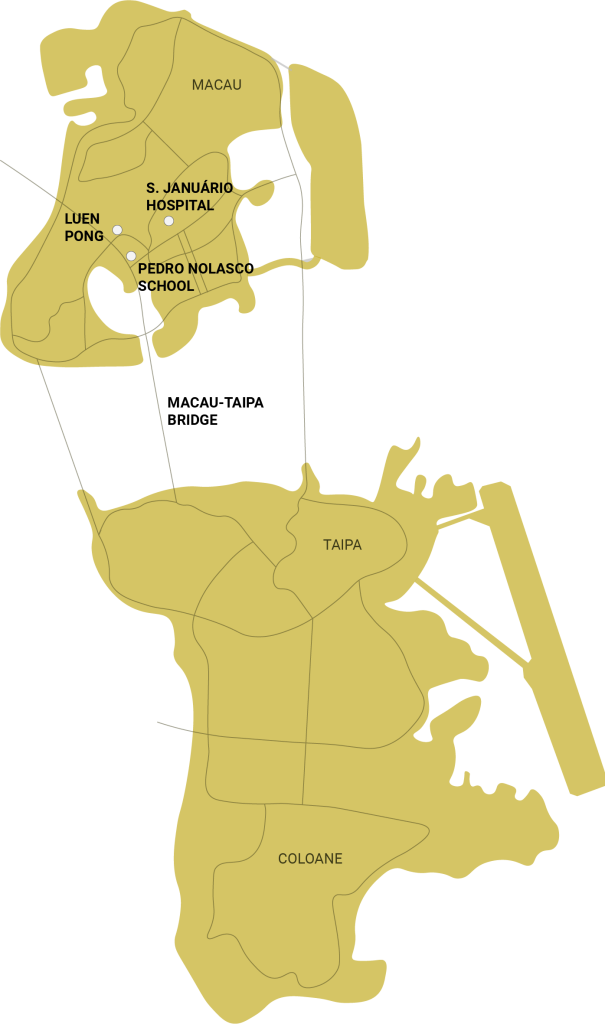
The project will span Macanese social-spatial history during the Portuguese administration since Ferreira do Amaral’s murder in 1849, which contributed to firming colonial governance, up to the political handover in 1999. Four case studies will be surveyed: the São Januário Hospital (1872, with many construction phases until 1958), the Inner Harbour (1883-1920s), the Pedro Nolasco Commercial School (1963-1968), and the Luen Pong Building (1960s-70s). Two others may be depicted during research to enhance particular issues.
Presently, the Macau government has shown interest in strengthening ties with Portugal as a way of building a Macanese identity. LabourMap-Macao also aims to foster these relationships, since filling this gap will contribute to strengthening the history of Macanese architecture and fulfilling society’s requests to understand the territory.
Host Institution: Iscte Conhecimento e Inovação (Iscte-CVTT)
Collaborative Institutions: Arquivo Histórico Ultramarino / Overseas Historical Archive (AHU); Docomomo Macau; Center for Architecture and Urbanism of Macau (CURB); University of Saint Joseph (USJ); National University of Singapore (NUS)
Funding: Portuguese Foundation for Science and Technology (2023.14980.PEX)


LabourMap-Macao is an Exploratory Project funded by the Portuguese Foundation for Science and Technology (2023.14980.PEX).
Beta trial disclaimer
The LabourMap-Macao team is responsible for the maintenance of this website, which is intended to facilitate public access to information about the group’s initiatives. Although this is still a beta trial, the intention is to release the information in a timely and accurate manner. Should any errors be brought to the attention of the team, they will be corrected.