

Call for Papers – Issue #4
Contemporary Construction Sites as Postcolonial Infrastructure: Preliminary Inquiries
Guest Editor: Nuno Tavares da Costa (University Institute of Lisbon)
Architectural discourse has privileged design, authorship and completed buildings over the material and social conditions through which architecture is seen. However, the construction site often remains disregarded as one of the least theorised spaces in architectural history.
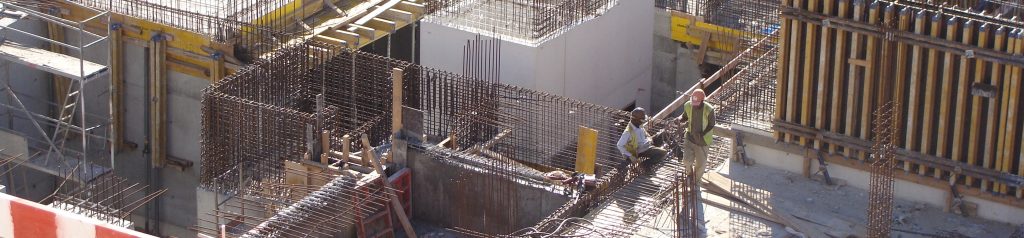
The present issue proposes un certain regard for this space, approaching it as an object of inquiry rather than merely the stage following the project before buildings’ completion. In a certain way, one could start asking if something changes in architectural history when the construction site overcomes the building as the object of analysis. Or, if our understanding of architecture shifts when we recognise the social, political and economic conditions that shape it? Or even if architectural design continues with the construction phase? In these preliminary inquiries, the construction site appears not simply as a place of building activity, but as a socio-spatial assemblage through which racial labour, logistics and technology become materially entwined. This perspective resonates with Henri Lefebvre’s proposition that space is socially produced, putting into consideration the construction site as one of its primary moments.
Instead of asking how buildings are constructed, this issue considers the possibility of a different architectural reading when observed through the construction site position. This becomes particularly relevant in the context of contemporary postcolonial urbanisation. Throughout Europe (and beyond), major public works and urban transformations have relied extensively on migrant labour, originating from former colonies or postcolonial territories. But these labour politics cannot be understood independently of the provident histories of colonial extraction, imperial mobility and racialised divisions of labour that supported European industrialisation and the welfare state. Is it possible that construction sites have become places where colonial histories continue to be reorganised through labour paradigms? If so, they invite us to reconsider buildings not simply as the materialisation of architectural ideas, but also as the crystallisation of wider social relations.
These relationships, established on the construction site, also expand beyond its boundaries, through the in-and-out movement of anonymous bodies, marginal to the city, somehow replicating the colonial cities’ social organisation, in the ruins of the post-imperial metropolis. Using an analogy, if infrastructures are the invisible systems that allow buildings and cities to function, labour could be implied as the invisible infrastructure of architectural production?! Western Modernity depended extensively upon racial labour, but workers usually remained absent in architectural representation. While buildings occupied the foreground of architectural images and histories, workers’ bodies were relegated to the background, as part of the landscape. Researching photographs, films, technical documentation and archival records of construction sites can reveal a divergent reading of their intended purposes. The construction site itself could then be approached as an archive of postcolonial spatial production?!
This issue encourages experimental contributions seeking to open a still underexplored research agenda. The format is set up to support findings, theoretical hypotheses, empirical observations and trial approaches. Contributions from PhD candidates, early-career researchers, independent scholars and established academics are equally welcome.
Please send your 300-word abstract to nmtca@iscte-iul.pt by 21 September 2026. All submissions should include a short biography (max. 100 words) and contact information for each author. Text submissions should be sent as .doc files. Where applicable, images should be submitted at 72 dpi as uncompressed .tif files. All accepted authors will be asked to submit a 6,000-word article in British English that will be subject to a double-blind peer review. Final publication is expected by early May 2027.
CALENDAR
Submission of abstracts: 19 October 2026 (EXTENDED)
Decision from editor: late October 2026
Submission of papers: 25 January 2027
Revisions: March 2027
Publication: May 2027