
Communication
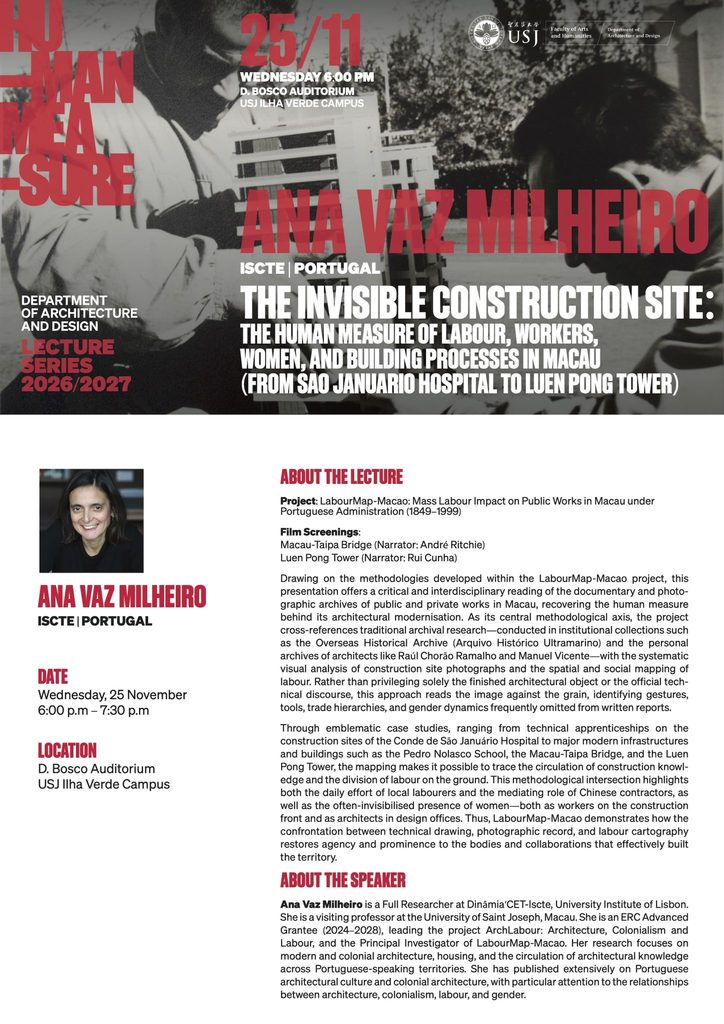
The Invisible Construction Site: The Human Measure of Labour, Workers, Women, and Building Processes in Macau (from São Januário Hospital to Luen Pong Tower)
Author: Ana Vaz Milheiro
Location: University of Saint Joseph, Macau (DAD 2026/2027 Lecture Series: Human Measure)
Date: 25 November 2026
Summary
Drawing on the methodologies developed within the LabourMap-Macao project, this presentation offers a critical and interdisciplinary reading of the documentary and photographic archives of public and private works in Macau, recovering the human measure behind its architectural modernisation. As its central methodological axis, the project cross-references traditional archival research—conducted in institutional collections such as the Overseas Historical Archive (Arquivo Histórico Ultramarino) and the personal archives of architects like Raúl Chorão Ramalho and Manuel Vicente—with the systematic visual analysis of construction site photographs and the spatial and social mapping of labour. Rather than privileging solely the finished architectural object or the official technical discourse, this approach reads the image against the grain, identifying gestures, tools, trade hierarchies, and gender dynamics frequently omitted from written reports.
Through emblematic case studies, ranging from technical apprenticeships on the construction sites of the Conde de São Januário Hospital to major modern infrastructures and buildings such as the Pedro Nolasco School, the Macau-Taipa Bridge, and the Luen Pong Tower, the mapping makes it possible to trace the circulation of construction knowledge and the division of labour on the ground. This methodological intersection highlights both the daily effort of local labourers and the mediating role of Chinese contractors, as well as the often-invisibilised presence of women—both as workers on the construction front and as architects in design offices. Thus, LabourMap-Macao demonstrates how the confrontation between technical drawing, photographic record, and labour cartography restores agency and prominence to the bodies and collaborations that effectively built the territory.