

PORT OF BEIRA AND RAILWAY, MOZAMBIQUE
The Port of Beira is located on the east coast of Africa, at the mouth of the Púngué [Pungwe]River in Mozambique. Construction began in the late 19th century as key infrastructure for the Mozambique Company’s territorial administration. The port’s development was influenced by the Anglo-Portuguese Treaty of 1891 and was closely linked to the expansion of two significant railway lines: the Beira Railway and the Trans-Zambezia Railway. The port and railway were expanded in several phases, mainly with British knowledge, capital and technology. Over the years, the port wasbeen equipped with a dozen wharves and an oil pipeline.
How to cite
ArchLabour: Architecture Colonialism and Labour (P.I. Ana Vaz Milheiro, ERC-funded 10.3030/101096606, 2024-2028). Port of Beira and Railway, Mozambique. Accessed on 10th March 2026. Available at: https://archlabour.iscte-iul.pt/port-of-beira-and-railway/
01. Plan & Construction
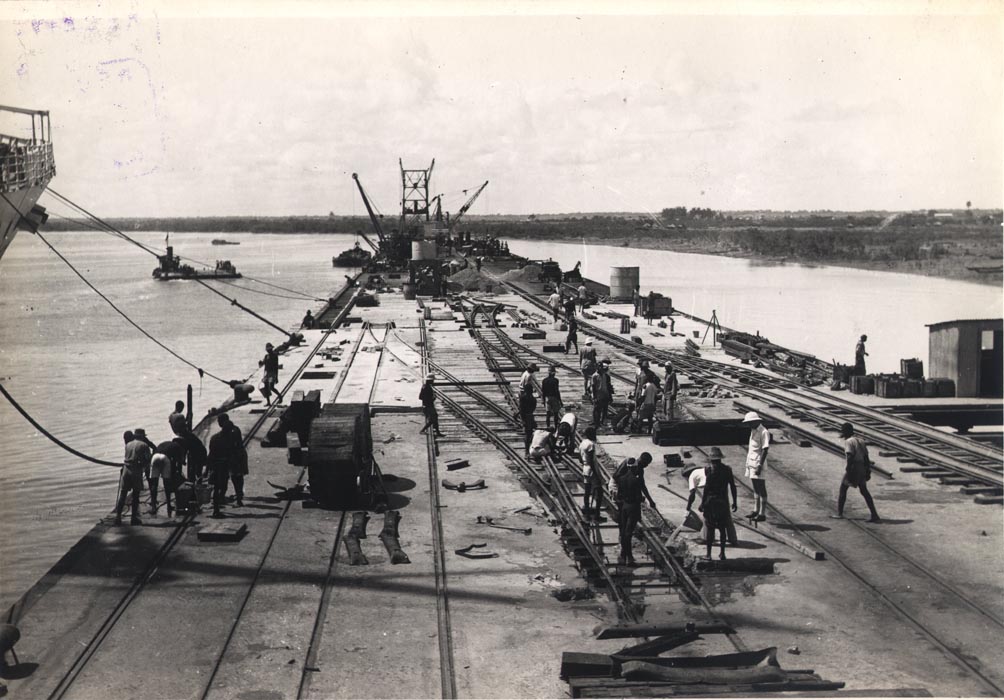
The construction of the Port of Beira was initiated by the Mozambique Company through successive contracts with the British firm Pauling & Lawley. The port underwent several expansions between 1926 and 1945 by the Beira Works Company, until it was nationalised by the Portuguese colonial government in 1949. Pauling was also awarded the contract for the Beira railway line, following studies by Eduard Pouhin and Renato Baptista, as well as a contract with Theodore Van Laun, an associate of Cecil Rhodes. Construction began in 1892, following a route designed by Mansergh. The line stretched 321 km from Beira to the Machipanda border, passing through several major towns in the Manica and Sofala regions: Dondo, Vila Machado, Gondola, Vila Pery and Vila de Manica..
02. Labour
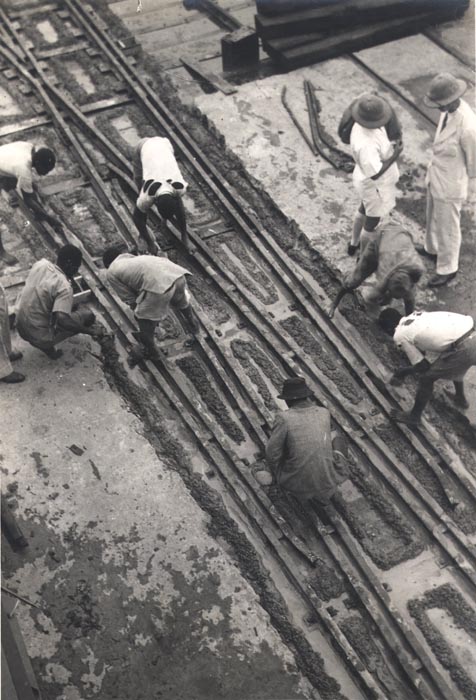
The location of the port was determined not only by the need to occupy that region of Mozambique, but also by the recognition of a labour force already present in the area. According to Paiva de Andrada, one of the port’s leading proponents, the mouth of the Púngué River offered excellent natural conditions and was “one of the regions where the largest number of indigenous workers could be found”. The Mozambique Company established its own network of African intermediaries responsible for recruiting African labourers. According to the 1950 Beira census, around 5,500 African men were employed at the port. There were also groups of white, mixed-race, and Asian workers.
03. Skills & Technologies
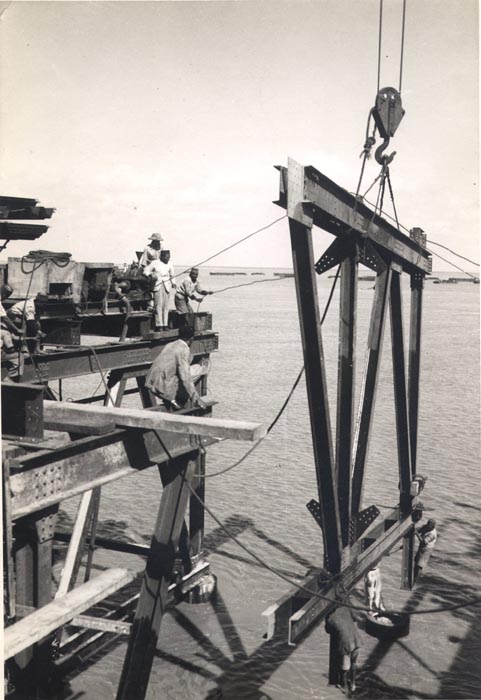
The photographs of the Beira Works Company show the progress of the construction and expansion of the port. This work included building defensive walls for Beira, constructing several berthing quays, installing electrical systems, installing lifts for transporting grain and coal, and laying Decauville lines to connect to the railway lines and transport materials. The quay structures required manual and specialised work on the foundations, including pile driving and stone crushing. Rolling and leader structures were assembled using heavy-duty cranes, wooden beams and air pumps, among other equipment.
Location
Archival Records
Visual Materials Outputs
Fieldwork
Other Related Outputs
Imperial companies and railways between Angola and Belgian Congo, 1910-1930