

Communication
Building São Januário Hospital in Macau: Portuguese technical perspectives on Chinese labour
Journal: : Architecture + Infrastructures Working Paper Series 1: Colonial and Post-Colonial Landscapes: Architecture, Cities and Labour
Author: Ana Vaz Milheiro
Print: Dinâmia’CET-Iscte, 2026
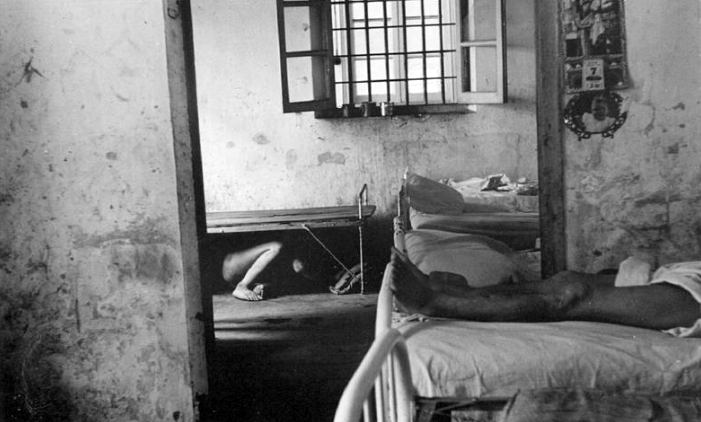
Infirmary: Conditions at São Januário Hospital c. 1951, [José dos Santos Baptista (Head of the Technical Department of Public Works) and Abel de Carvalho (Radiologist)], Study on the Renovation and Expansion of the Conde de São Januário Central Hospital in Macau, 1951. MO/AM/DA/031/1
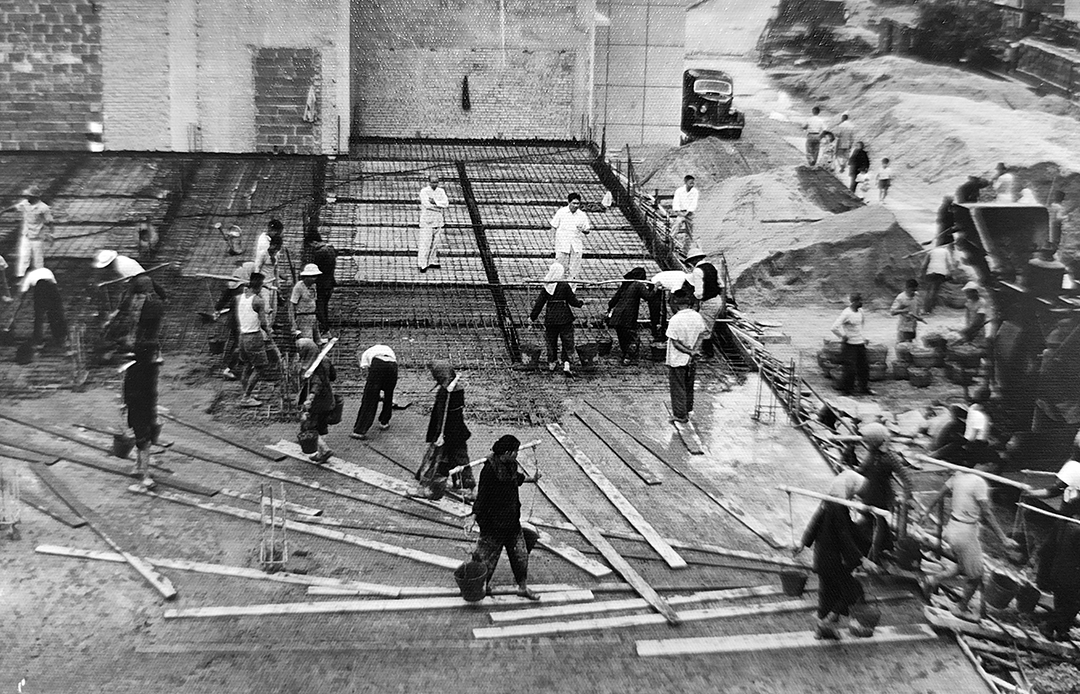
Concreting of the 1st Floor. Arnaldo Luiz de Siqueira Basto, RTOPM, 1956 Report (1956). AHU, OP03394.
Summary
The historical context of the Conde de São Januário Central Hospital (CHCSJ) in Macau dates to the 1870s. It began as a military hospital under Portuguese administration. The original structure was later replaced in the 1950s with facilities that complied with the rigorous technical standards required for treating tropical diseases. This construction process aligned with the concept of “welfare colonialism,” as described by Bradley (1955), whereby infrastructure became a tool for legitimising the colonial presence.
This research is part of the LabourMap-Macau project and examines the construction of the CHCSJ during two key periods, corresponding to different contracts and interventions: the 19th century and the post-World War II era. Archival documents from 1873 highlight the Portuguese technical team’s deep interest in the Chinese workforce and the gradual “Westernisation” of architectural practices adopted by local labourers. The hospital’s initial construction involved complex bidding processes with companies from both Macau and Hong Kong. During this phase, Portuguese staff faced significant challenges, such as the absence of the metric system among local teams. These challenges required the development of conversion tables and practical solutions to overcome language barriers and ensure the implementation of European design ideas. By the mid-20th century, global construction systems had been fully integrated into Macau. There was a consolidated confidence in the quality of Chinese labour, and recruitment processes had become more streamlined. Notably, official reports from this period show that women were present on construction sites as part of the workforce, with their names explicitly included in technical records. Although both the 1873 pavilion and the 1954 Estado Novo representative building have since been demolished – replaced by a modern structure in 1989 – the histories linked to their construction and the dynamics of their labour force remain vital aspects that revive their historiographical presence and cultural legacy in Macau.
Click here to download the paper.