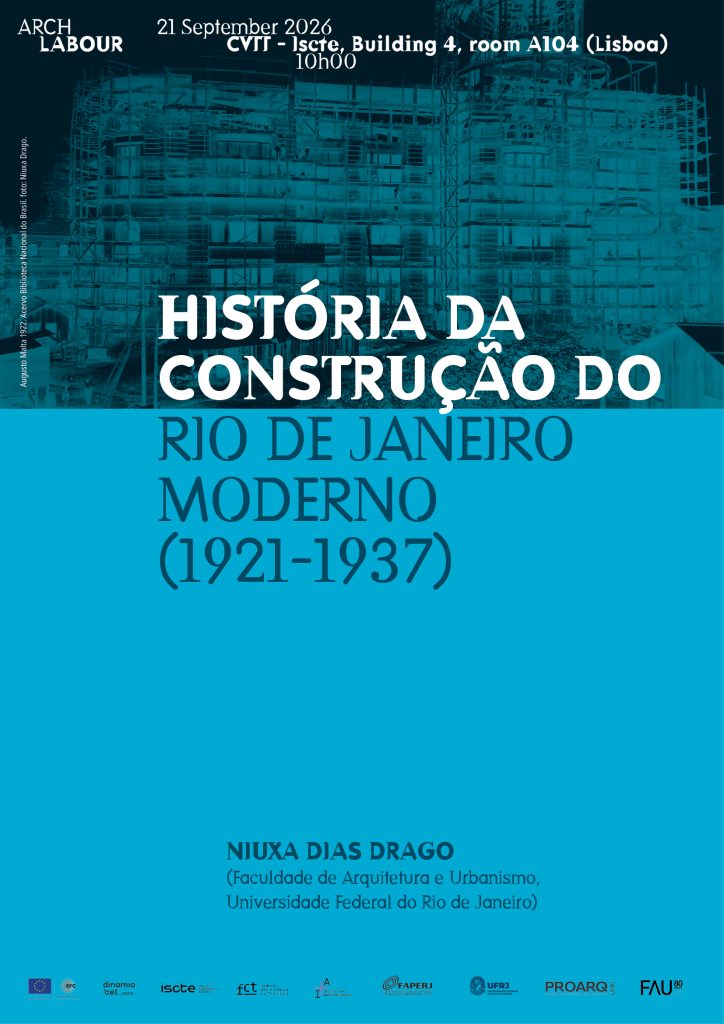

História da construção do Rio De Janeiro moderno (1921-1937)
Authors: Niuxa Dias Drago (Faculdade de Arquitetura e Urbanismo da Universidade Federal de Rio de Janeiro, FAU/UFRJ)
Date: 21 Setembro 2026, 10 AM
Location: CVTT-Iscte, Building 4, Room A104, Lisboa
Summary
The lecture presents the research developed by Prof. Niuxa Drago and her team at the Laboratório de Narrativas em Arquitetura (LANA), part of PROARQ, at the Faculty of Architecture and Urbanism of the Federal University of Rio de Janeiro (UFRJ). The research focuses in particular on the introduction of reinforced concrete in building construction in the central area of Rio de Janeiro. It examines technical and urban legislation, the flow of materials, and actors involved — designers, contractors, and workers — linking to the study of technological, typological and landscpe transformations.
As case studies, the lecture will present the construction of the pavilions of the International Exposition marking the Centenary of Brazil’s Independence (1921–1923), the construction of the Regina Building (1932–35) in Cinelândia, based on its legal file held in the Rio de Janeiro city archive, and the construction of the concrete structure of the Ministry of Education and Health building (1937), based on the collection of construction site images held at the Research and Documentation Center of FAU-UFRJ. The talk will also present notes on civil construction workers in the 1920s, drawn from newspaper articles, as well as the connection between major concrete construction projects and the growth of favelas.
Acordo ERC-CONFAP (Conselho Nacional das Fundações Estaduais de Amparo à Pesquisa)